Showing posts with label #PKN. Show all posts

Friday, January 17, 2014

From Seeking to Sharing: a story about PLNs and Curation


This is a story about my curation and my PLN [Personal Learning Network].

Most days, I end up filing the cornucopia of blog posts, listserv and RSS feeds that come across my browser or email inbox into folders. Occasionally, they ‘grab’ me, lure me into actually reading them and following their breadcrumbs. And, since I am currently engaged in the the free Curatr Digital Curation mini MOOC (Massive Online Open Course), put together by Sam Burrough and Martin Couzins,  I decided that this blog post would represent my ‘call to action’ – my ‘ah ha’ moment.

The post was an insightful analysis by Harold Jarche, a man I consider to be a PLN ‘guru’. Jarche’s visuals curate his Seek>Sense>Share continuum by placing these three elements into a grid comprised of sense-making and sharing:
http://www.jarche.com/wp-content/uploads/2014/01/PKM-quadrants-520x390.jpg

Jarche then takes Patrick Lambe’s 6 PKM roles[i] and plots them on the same coordinate grid based upon each role’s levels of sense-making and sharing:

http://www.jarche.com/wp-content/uploads/2014/01/PKM-6C-520x390.jpg


Being intrigued, I decided to further investigate Lambe’s 6C’s  to learn more about my own curation push ↔ pull tendencies. And, after answering his self-assessment questions, found that I was a ‘collector’. [No news there!] Reading Tan’s introduction, I was (only somewhat) mollified by his observation: “different people have different personality types, and different personality profiles in relation to their personal knowledge affinities and capabilities.” I tallied my ‘tendencies’ to visualize my profile:

How I Scored on Lambe's scale
Looks like I’m doing OK on Jarche’s SEEK and SENSE. My goal, however, is the upper right quadrant: to be actively sharing. Here, then, are the goals I derived from this exercise:
  • relationship-building to enhance the ‘connection’ (especially with my audience) and
  • packaging and presentation to be a more consistent ‘creator’
Mike Fisher did a nice job of visualizing the Collection/Curation dichotomy as a continuum. So I'll leave you with one more image to ponder:


and challenge you to think about where you’re spending your time and how to move your own efforts to the right-hand side. Try taking Lambe’s assessment and share what you learned about your own style and what you intend to do to modify it.

RESOURCES:

Fisher, Mike. "Collection or Curation?" Digigogy. N.p., 11 June 2012. Web. 17 Jan. 2014. <http://digigogy.blogspot.com/2012/06/collection-or-curation.html>.
Jarche, Harold. "PKM Roles." Harold Jarche: Seek > Sense > Share. N.p., 12 Jan. 2014. Web. 16 Jan. 2014. <http://www.jarche.com/2014/01/pkm-roles/>.
Taylor, Donald H. "Skills for 21st Century L&D Professionals." N.p., 13 Dec. 2013. Web. 17 Jan. 2014. <http://donaldhtaylor.wordpress.com/2013/12/13/skills-for-21st-century-ld-professionals/>.
Lambe, Patrick. "Personal Knowledge Management: A DIY Guide to Knowledge Management - Part 2." Green Chameleon. Straits Knowledge, 2002. Web. 16 Jan. 2014. <www.greenchameleon.com/thoughtpieces/pkm.pdf>.
Tan, Edgar. "Personal KM: a DIY Guide to Knowledge Management - Part 2." Green Chameleon. N.p., 23 Apr. 2003. Web. 17 Jan. 2014. <http://www.greenchameleon.com/gc/guide_detail/personal_km_a_diy_guide_to_knowledge_management_part_2/>.
Zierten, Charity. "What Is 'Content Curation' Anyway?" Socially Engaged Marketing, 18 Apr. 2012. Web. 17 Jan. 2014. <http://www.sociallyengagedmarketing.com/2012/04/content-curation/>.


[i] Notes on Lambe's types:
  • Collector – mind-mapper, knowledge organizer
  • Connector – conversation, relationship-builder
  • Communicator – storyteller, targets audience
  • Creator – originator, translator
  • Critic – analytical, authenticity, reality-check
  • Consumer - passive


Friday, October 18, 2013

On the Need for "Due Diligence" in 21st Century Critical Literacy Skills


A post from Catherine Lombardozzi, one of the thought leaders I follow as part of my PLN RSS feed, popped for me and I just had to share it with other members of the MetaliteracyMOOC and readers of my blog.

The blog post, Perils of popular science (October 17, 2013) raises questions about the increased need for 'due diligence' in 21st century research and scholarship.

Since my response to her post is awaiting moderation, I'll share it with you here:

Catherine, this is a great example of why those of us in the library profession make such a big deal about the concept of “information literacy” or ‘Metaliteracy,’ as some are suggesting we call it in the 21st century. With the advent of OERs – with the plethora of curation tools and the ‘noise’ they can generate – with self-publication AND self-promotion being so readily available and accessible, critical literacy becomes increasingly important. Caveat emptor!

Are your ideas about critical evaluation changed or sparked by Lombardozzi's blog post?

Thursday, September 26, 2013

Getting MESSAGES BACK and STARTING/CONTINUING/DEVELOPING CONVERSATIONS


To continue my previous post Getting the MESSAGE OUT and Getting MESSAGES BACK – About Blogging as a Tool and Tools in General [i], I’d like to tell you a story about a PKN (Personal Knowledge Network) journey I recently took.

To frame this PKN experience, I should preface it by giving you some context: I am interested in Learning in Organizations, both “Learning Organizations” AND “Organizational Learning”. In researching the topic, I found/discovered Jane Hart, Collaboration Consultant and founder of the Centre for Learning & Performance Technologies (C4LPT), one of the world’s most visited learning sites on the Web.[ii] A webinar ‘junkie’, I attended a GoToTraining Webinar on Social and Collaborative Learning in the Workplace given by Jane Hart (August 2012)[iii] and added her blog, Learning in the Social Workplace, to my Outlook RSS feed reader.

This story demonstrates how discovery doesn't necessarily occur in chronological order.
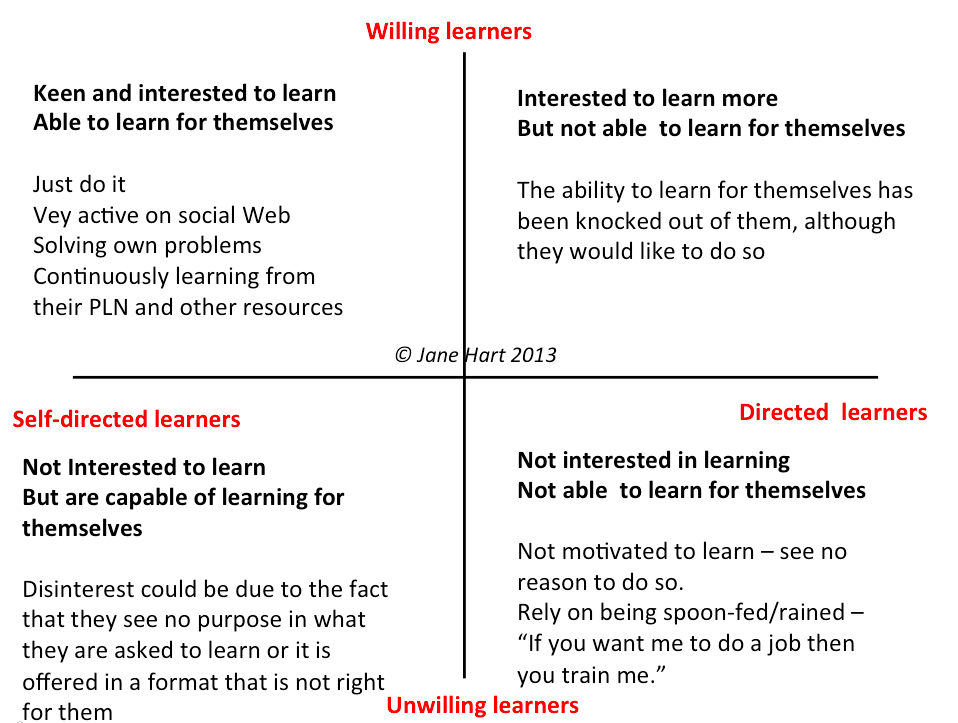
  1. It starts with Hart’s blog post “How do we deal with unwilling corporate learners?” (September 22nd), which responds to Schlenker’s blog comment:  The truth is, there are no learning problems in corporate settings. There are only people unwilling to learn” (September 20th). Hart’s post develops a wonderful matrix of self-directed/directed and willing/unwilling learners, which I just had to share with the Metaliteracy MOOC.
  2. My blogging juices get flowing and I write my “Getting the MESSAGE OUT” post (September 25th) which is fueled by Hart’s ideas. I agree with Schlenker’s other blog statement:Learning is about People, NOT technology” and need to follow up on his observation that “people still don't take advantage of new technologies for learning” and that “so many workers choose to leave their learning in the hands of others.”
  3. More on the topic from Clark Quinn (another blogger in my RSS feed and, like Hart, a member of the Internet Time Alliance): “Being explicit about corporate learning” (September 25th) [unfortunately, AFTER I had posted mine]. Quinn observes that “the ability to be a self-directed learning is a skill issue” and that “learning-to-learn or meta-learning skills may or may not exist in any particular individual” which can be explicitly developed while willingness to learn is a question of responsibility and attitude. [The issue of attitude is one Quinn addressed back in April 2006 and he hyperlinks back to that earlier blog post.] He concludes by coupling learning environment with culture: “Learning has to be explicit, safe, valued, modeled, and expected. Learners need to be empowered with tools, coached, and formatively evaluated.
  4. I now feel the need to chronicle the way ideas are shared, thoughts are developed and connected in an asynchronous environment through blogs. And, knowing that an image helps, put this mindmeld into a graphic.


The end of the saga leading to this post.

So, dear readers, I ask you: 
  • Is it the technologies? 
  • Is it attitude? 
  • Is it willingness? 
  • Do you see yourself in some of these observations? 
  • Do you feel the tools are empowering? 
  • Or overwhelming? 
  • Are you comfortable with asynchronicity? 
  • Do you agree that this is part of metaliteracy?


REFERENCES:

Hart, Jane. "How do we deal with unwilling corporate learners?." Learning in the Social Workplace. N.p., 22 Sept. 2013. Web. 26 Sept. 2013. <http://www.c4lpt.co.uk/blog/2013/09/22/how-do-we-deal-with-unwilling-corporate-learners/>.
Herzog, Kate S. "Getting the MESSAGE OUT and Getting MESSAGES BACK – About Blogging as a Tool and Tools in General." Beyond Information Literacy. N.p., 25 Sept. 2013. Web. 26 Sept. 2013. <http://beyondinformationliteracy.blogspot.com/2013/09/getting-message-out-and-getting.html>.
Quinn, Clark. "Attitudinal Change." Learnlets. N.p., 20 Apr. 2006. Web. 26 Sept. 2013. <http://blog.learnlets.com/?p=40>.
Quinn, Clark. "Being explicit about corporate learning." Learnlets. N.p., 25 Sept. 2013. Web. 26 Sept. 2013. <http://blog.learnlets.com/?p=3506>.
Schlenker, Brent. "Welcome back..." Corporate eLearning Strategies and Development. N.p., 20 Sept. 2013. Web. 26 Sept. 2013. <http://elearndev.blogspot.co.uk/2013/09/welcome-back.html>.


[i] Herzog, Kate S. “Getting the MESSAGE OUT and Getting MESSAGES BACK – About Blogging as a Tool and Tools in General http://beyondinformationliteracy.blogspot.com/2013/09/getting-message-out-and-getting.html

[ii] Hart is a prodigious and knowledgeable blogger [see her “Quick Guide to Blogging Tools”  http://c4lpt.co.uk/top100tools/quick-guides/quick-guide-to-blogging/],  author of the Social Learning Handbook, surveyor of “The Top 100 Tools for Learning” (results of results of the 7th Annual Learning Tools survey http://c4lpt.co.uk/top100tools/ will be released 9-30-13) and author of “A Practical Guide to the Top 100 Tools for Learning,” which describes the essential features of each tool. I could go on extolling her accomplishments…but it suffices to say she IS one of my role models.

Wednesday, September 25, 2013

Getting the MESSAGE OUT and Getting MESSAGES BACK – About Blogging as a Tool and Tools in General


The topic I’m currently pondering is Blogging, a tool that provides a platform on which you can crystalize your thoughts, opinions, or views into an Internet post. If your purpose is to do only that – to create an artifact (perhaps because it is required for your course), you probably don’t care about “What happens then?” But every guide to blogging I’ve read says that its goal is to engage the reader – in contemplation and/or in conversation – to grow and develop the thought and to get feedback from your readers. Blogging is a way of finding a virtual community.

So I wanted to say how much I appreciate the Metaliteracy MOOC Daily Newsletter, which serves as an aggregator of Participants' Blog Posts, New Discussion Threads, Comments, Diigo Posts, and Twitter Posts. However, this MOOC’s aggregation software DOES frustrate me – it does NOT collocate materials. Comments on Blog Posts and New Threads don’t sit with the materials that spawned them. And the software leads one to comment, not on the page where the post resides (where is WOULD be collocated as a thread) but in a chronological stream of comments. Does anyone else find this frustrating? Have you considered posting your comment directly on the blog, rather than (or in addition to) doing so using the MOOC’s comment link?

Sunday, September 22, 2013

Metalearning: Learning How to Learn (part 1)


I came upon a very relevant blog post from Jane Hart (one of the sources I use in my “Learning Organization” PLN): How do we deal with unwilling corporate learners?
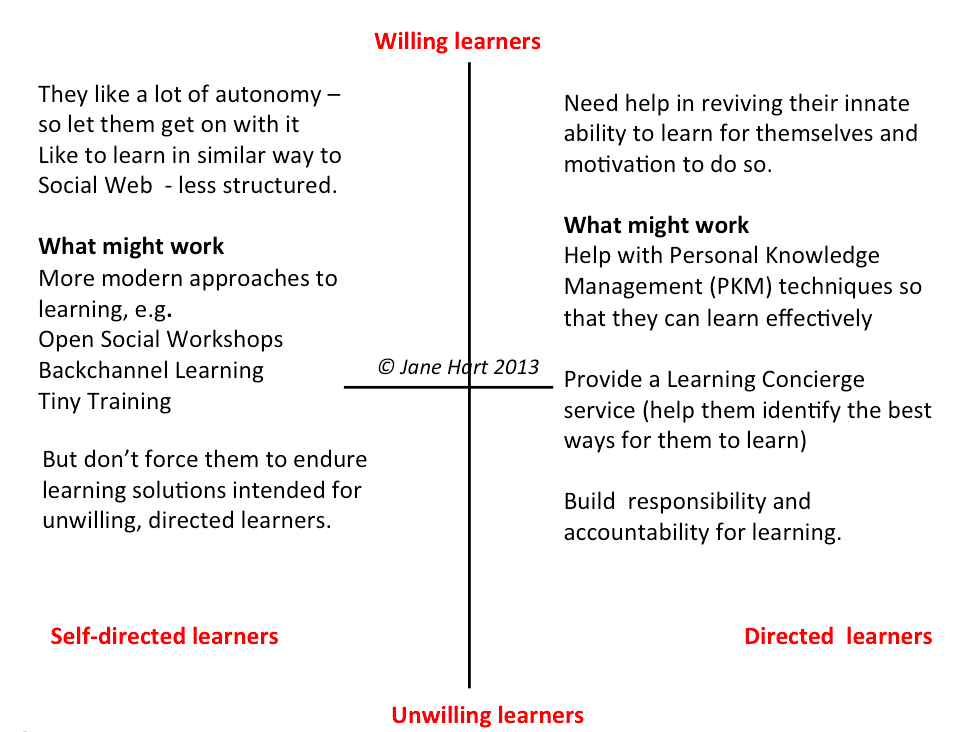
Hart, whose blog posts often contain quite informative visuals, notes that people who are independent (willing) learners will learn regardless of teaching methodology. Unwilling learners, on the other hand, expect to be taught. Since instructional designers and trainers try to motivate the unwilling, their methods often frustrate their more willing classmates. She also observes that there are those who are willing to learn but don’t know how to learn independently. What they need is direction - “help to revive their innate ability to learn.” Finally Hart notes that unwilling, traditional (directed) learners need help in becoming self-directed, finding suitable learning styles, and help in taking responsibility and accountability for their own learning. [There is a lesson for teachers in Hart’s message: one size cannot fit all learners.]


Learner Characteristics
http://www.c4lpt.co.uk/blog/wp-content/uploads/2013/09/Screen-Shot-2013-09-22-at-09.26.22.png
What Learners Need
Sharon Boller, a well-respected instructional design guru, notes in her response to Hart’s blog the importance of creating a “self-directed environment.” She also observes that “information overload is not conducive to a self-directed approach to learning.” On the corporate side, she perceives “The luxury of time is an essential ingredient to a self-directed learning approach. You need time to explore, time to make some mistakes, time to reflect on what it is you are learning. Corporate America is very short on time. Hence, I think we’ve evolved directed approaches to learning that try to minimize the time required for people to learn…. I also think we do a poor job in corporate American at distinguishing what we truly need for people to learn to do and what we simply want them to be able to find/locate as they need it. So we create overly elaborate learning solutions for things that we don’t really intend for people to remember and under-cut the learning situations that need to be far more robust for people to truly gain skill or in-depth knowledge.”
The moral of this story for teachers is to focus on problem-solving, rather than on facts that can be referenced when needed.

Source: Hart, Jane. "How do we deal with unwilling corporate learners?." Learning in the Social Workplace. N.p., 22 Sept. 2013 Web. 22 Sept. 2013. <http://www.c4lpt.co.uk/blog/2013/09/22/how-do-we-deal-with-unwilling-corporate-learners/>.